What to Do When Your Water Heater Is Leaking in Tampa
Published 2026-09-02 · Mr Water Heater Team · Florida Master Plumber Licence CFC1433539.
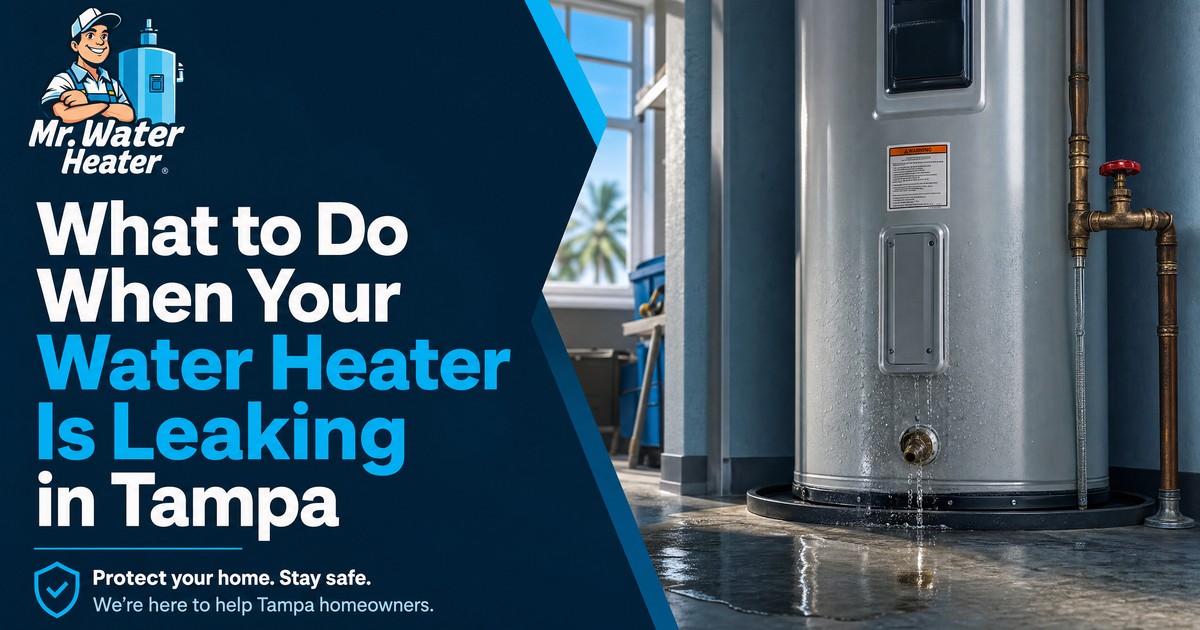
If your water heater is leaking in Tampa, keep people away from hot or electrified water. Shut off the cold-water supply, then turn off the electric breaker or gas control only if you can do so safely. Contain water without opening the unit, document the damage, and arrange a licensed inspection to determine repair or replacement.
If your Tampa water heater is leaking, keep people away from hot or electrified water. Close the cold-water supply if the route is safe, then isolate electric power or gas only when you can do so without exposure. Contain the water, document the condition, and arrange a licensed inspection before attempting any repair.
A leaking water heater can damage flooring, drywall, cabinets, or belongings fast. Resist the urge to remove panels, tighten fittings, or relight burners.
The order that matters:
- Protect people
- Stop the incoming water
- Isolate energy when it is safe
- Limit the spread
- Record what happened
This guide is for Tampa-area homeowners with a conventional storage-tank water heater. It covers safe observations and the information that helps a plumber find the source.
Stop and get emergency help instead if water is spreading rapidly, the tank is bulging, gas is suspected, or the shutoff is unsafe to reach.
Start with safety before touching the heater
Look at the room before you approach the appliance.
- Keep children and pets away
- Do not step into standing water that may have reached outlets, cords, the electrical panel, or heater controls
- Do not touch the heater, a wet switch, or any metal object nearby until electrical and gas hazards have been considered
If anyone is injured or in immediate danger, move to safety and contact emergency services.
For an electric water heater
Switch off the dedicated circuit breaker only if you can reach the panel from a dry, stable surface and the route is clear. Use the labelled breaker when its identity is obvious.
Do not:
- Open access panels or remove insulation
- Touch wiring
- Keep resetting a breaker that trips
Repeated tripping can indicate water intrusion or another electrical fault. Leave the circuit off and arrange qualified diagnosis.
For a gas water heater
Treat a gas odour, a hissing sound, or any suspected gas leak as an evacuation issue.
Avoid flames, cigarettes, light switches, phones in the immediate area, and other ignition sources. Leave the building and contact the gas utility or emergency services from outside.
If there is no gas odour and you can approach the appliance safely, follow the manufacturer's instructions for the gas control. Do not disassemble the burner, the valve, or the vent.
Close the water supply and contain the leak
Find the right valve
The cold-water supply valve sits on the pipe entering the top of the tank.
- A quarter-turn ball valve is closed when the handle is perpendicular to the pipe
- A multi-turn gate valve usually closes clockwise
Turn gently. Do not force a corroded or seized valve. If the local valve will not close, use the home's main water shutoff — but only if you know where it is and can reach it safely from a dry position.
Do not confuse it with the relief valve
The temperature-and-pressure relief valve and its discharge pipe are safety components, not routine shutoffs.
Never lift the relief lever, cap the pipe, or plug its outlet. Opening it can release very hot water and start another uncontrolled discharge.
Watch what happens next
Once the supply is closed, see whether the flow slows. Continuing flow may come from stored tank contents, the relief-valve discharge, a drain fitting, or a nearby pipe.
Do not use hot-water fixtures to drain the tank unless a plumber has told you to. The tank may hold very hot water, and a hose can discharge unexpectedly.
Contain the water
Working from a dry, stable position, use towels, a shallow pan, or a wet vacuum if electrical safety is certain. Move rugs, boxes, cleaning products, and possessions clear of the water without walking through a hazardous area.
Do not:
- Tape a pressurised joint or clamp a gas line
- Pull the appliance away from the wall
- Place a container where it requires contact with hot surfaces
If water has reached drywall, cabinets, flooring, or a lower level, limit further exposure. Do not open walls or flooring before the condition is documented.
Record the condition and locate the visible source
Photograph before you move anything
Capture the heater and the room, including:
- The water path and any wet materials
- Damaged belongings
- The model and serial-number label
- Visible connections
- Close-ups paired with wider shots showing location
A short video can show the dripping direction or rate without moving the appliance.
Note when you noticed the leak, whether the water is hot or cold, which shutoffs you closed, and whether the flow changed.
Inspect with your eyes and a flashlight
Once the unit is isolated and the area is safe, start at the top — water travels along the tank jacket and piping, so the wet spot is rarely the origin.
Check the:
- Cold-water inlet and hot-water outlet
- Shutoff valve and dielectric fittings
- Flexible connectors and nearby joints
A bead at an external connection may point to a serviceable part, but corrosion can hide the real source. Do not tighten a fitting with a wrench while the system is hot, pressurised, or connected to gas or electricity.
Check the safety components — without operating them
Inspect the relief valve and its discharge pipe without touching the lever. Water at the end of that pipe can mean a pressure or temperature condition, a valve problem, or something else needing evaluation.
Check the drain valve near the bottom too. Do not force its handle, insert tools, or remove it. The area can stay hot after energy is isolated.
Rule out the neighbours
Look beneath the tank and around its base ring, but do not lift or lean the appliance. A washing-machine hose, water-softener line, condensate line, supply pipe, or fixture can wet the same floor.
Trace the highest wet point you can see without moving the heater. Then tell the plumber where the water appears, whether it is hot, whether a fixture changes the flow, and whether closing the supply made a difference.
That is communication, not a do-it-yourself diagnosis.
Tank rupture or repairable connection?
The important question is whether water comes from an external component or from the storage vessel itself.
Often repairable
An inlet or outlet connection, shutoff valve, relief valve, drain valve, or nearby pipe may be serviceable after safe isolation. The plumber weighs the part's condition, the heater's age and model, the surrounding piping, and whether pressure, temperature, expansion, or installation conditions contributed.
More serious
A tank-body leak is a different matter. The steel vessel sits behind an outer jacket and insulation, so the true origin may be invisible.
These signs point toward internal vessel failure:
- Water under the tank
- A wet base seam
- Corrosion on the shell
- A bulge in the tank
- A leak that continues after external connections are dry
Do not drill, puncture, weld, seal, coat, or remove the jacket. Exterior patching is not a reliable tank repair. Replacement may be necessary, but the source should be verified first.
Two more things not to do
Do not keep an electric unit energised just to see whether it still works. Do not relight or adjust a gas burner after water has reached the controls or combustion components.
A temporary reduction in dripping proves nothing. Stored pressure, heating, movement, and water use can all change the flow again.
Know when the leak is an emergency
Leave immediately and call from outside
- A strong gas odour, or hissing near a gas appliance
- Any suspected gas leak
Do not search with a lighter, operate switches in the affected area, or attempt burner and gas-valve repairs.
Keep away and seek emergency assistance
- Sparks, smoke, a burning smell, or buzzing
- A wet electrical panel
- Standing water around outlets
- Damaged wiring
- A heater that repeatedly trips its breaker
A plumber may coordinate with an electrical professional, but you should not open energised equipment or approach a wet panel.
Urgent, but not evacuate-immediately
- Rapidly spreading water
- A ruptured or bulging tank
- Water entering ceilings or walls
- An unstable base
- Being unable to close the supply
In a multilevel Tampa home, water can travel well beyond the heater closet before surface damage shows. Shut off the main water only when you can reach it from a safe, dry position.
Renters and condominium residents should also follow the property's emergency reporting procedure once they are safe.
Even a controlled drip at an accessible connection needs prompt service. Restrict the area and arrange an inspection rather than leaving water and energy on. Mr Water Heater provides 24/7 emergency service for water-heater failures and urgent plumbing issues.
Leaking water heater cost factors
The word "leak" does not identify the work or the cost. The source may be a valve, a connector, a relief device, a drain fitting, a nearby pipe, or the tank shell.
Cost factors include:
- Access to the heater
- Corrosion, and the need to isolate or drain the unit
- Availability of compatible replacement parts
- Code-related corrections
- Water-damage cleanup
Gas equipment may need venting and combustion-safety attention. Electric equipment may need its connections, controls, and water intrusion inspected after de-energising.
If replacement is the answer
The assessment may cover capacity, location, connection changes, disposal, surrounding plumbing, and required installation modifications.
A pressure, expansion, temperature, sediment, or safety-device issue may also need attention, so a new leak does not follow the old cause.
Ask the plumber to separate immediate safety work from recommended follow-up, and to explain what the inspection found. Exact pricing for a Tampa home should follow an on-site assessment, not a generic online figure.
For an insurance claim
Photograph structural or personal-property damage before disposal where practical. Notify your insurer and ask what records, receipts, mitigation documentation, or inspections they require.
Coverage depends on the policy and the circumstances. A plumber can document findings but cannot decide coverage.
What professional help includes
A licensed plumber starts with a controlled safety assessment: heater type, isolation status, standing water, access, visible damage, and the highest wet point.
The inspection then covers:
- Cold-water and hot-water connections
- Shutoff valve and flexible connectors
- Nearby piping
- Drain valve and relief valve
- Base, seams, corrosion patterns, and jacket
Draining or depressurising is done with suitable procedures. Homeowners should not imitate those steps while the water may be hot or the energy is still connected.
By fuel type
- Electric: the breaker, wiring, controls, elements, and evidence of water intrusion — evaluated after the circuit is safely de-energised.
- Gas: the gas control, burner area, vent connection, draft-related concerns, and combustion components.
A relief-valve discharge is a symptom to investigate, never a fitting to cap.
Possible outcomes
A connection repair, a safety-component replacement, related piping work, tank replacement, or coordination with electrical, gas, or water-mitigation professionals.
Mr Water Heater handles tank troubleshooting, repair, replacement, installation, and maintenance, along with leak detection and repair, relief-valve inspection, tank flushing and sediment removal, and anode-rod inspection or replacement.
Review the tank water heater repair service for the relevant route. For broader home piping or fixture concerns, see the residential plumbing service.
Tampa conditions and prevention after the visit
Warm, humid Tampa weather increases moisture damage in a closet, garage, or cabinet. Mineral-bearing water contributes to sediment and component wear.
Once the leak is controlled, ask about:
- Tank condition and water pressure
- Thermal expansion
- Sediment buildup
- Safety devices and shutoff access
Then keep the heater accessible, learn where the main shutoff is, and label the dedicated breaker where appropriate. If you rent or live in a condominium, find out your property manager's or association's emergency procedure before you need it.
Quick questions homeowners ask
Should I turn off water before power or gas?
If you can reach the cold-water valve from a dry, safe position, close it first to limit incoming water. Then isolate electric power or gas following the safety guidance above. If water has reached electrical equipment or gas is suspected, leave the area and use emergency assistance instead of approaching either shutoff.
Can I use the heater if the leak is small?
Do not assume a small drip is harmless. Isolate the supply and energy when safe, restrict access, and arrange an inspection. A connection may be repairable, but a tank-body leak or relief-valve discharge can worsen. Continued heating and pressure can increase the damage even when the initial flow looks limited.
How can I tell whether the tank has failed?
Water from under the tank, a wet base seam, shell corrosion, a bulge, or a leak that continues after visible connections are dry all point toward tank failure. None of these confirm the diagnosis on their own. Do not remove the jacket or panels — a licensed plumber should verify the source.
What information should I give the plumber?
Share whether the unit is electric or gas, its location, the model and serial number if available, the apparent leak location, the water temperature, which shutoffs you closed, and any change in flow. Mention gas odour, electrical symptoms, spreading water, and structural damage. Photos and a short timeline help the plumber prepare without unsafe homeowner investigation.
Is a leaking water heater always replaced?
No. A leaking valve, connector, drain fitting, relief valve, or nearby pipe may be repairable after isolation. A failed tank shell, severe corrosion, or an unsafe appliance condition may call for replacement. The professional evaluates the source, tank condition, components, access, and installation factors before recommending a next step.
Final CTA: arrange safe professional help
A deliberate response protects people and property. Restrict access, isolate water and energy when safe, contain the spread, document the condition, and avoid disassembly.
Do not open electrical panels, work on gas controls, block a relief pipe, or try to patch a tank.
Who you are calling
- Family-owned and operated, serving Tampa and surrounding communities
- Licensed and insured, with 25 years of experience
- Florida Master Plumber Licence CFC1433539
For a leaking water heater Tampa homeowners need assessed, Call Mr Water Heater at +1 727 203 8201 or contact Mr Water Heater.
If there is gas odour, fire, electrical danger, or an immediate threat to life, leave the area and contact emergency services or the appropriate utility first.
Safety note: This article gives general homeowner guidance. It is not a substitute for an on-site diagnosis. If you smell gas, see fire or sparks, face electrical contact, or cannot safely approach the appliance, leave the area and contact emergency services or the appropriate utility before calling a plumber.
For a leaking water heater Tampa homeowners need assessed, Call Mr Water Heater at +1 727 203 8201 or contact Mr Water Heater.